With more people working remotely than ever before, the need to communicate ideas effectively is imperative to business success. Time is a hotter commodity than prior to Covid-19, and due to school closures many parents now need to multitask homeschooling and their day jobs. My husband and I are both working from home, but having three children in the house during working hours presents a special set of challenges. The ability to present ideas effectively, therefore, has become one of the most important requirements of our work lives.
If your role requires you to quickly disseminate information to groups, it is important to know how to effectively get your point across. Although public speaking is still cited as the most reported phobia, preparing to share information doesn’t have to be difficult if you know the basic components of an effective presentation.
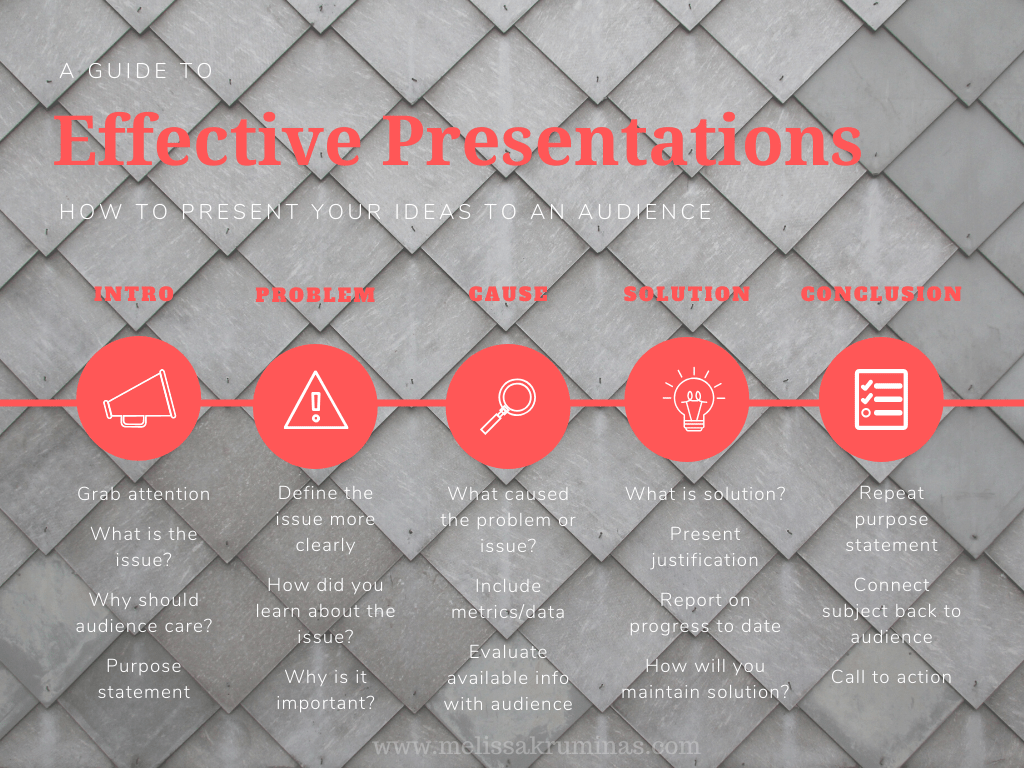
Presentations can be as simple or as complex as needed, but sticking to these five basic components will help you to prepare an effective presentation both remotely, as well as out in the field once your work life returns to normal.
Introduction
Strong introductions share many of the features of a strong paper or a great speech. First, you need to grab your audience’s attention. Common strategies include utilizing quotations or statistics, but my favorite way to grab attention is through the use of stories. Historical accounts, news stories, fiction, pop culture, cartoon stories, videos, and personal accounts are all stories. Stories transform cold data into relatable information.
Once you have your audience’s attention, it is important to define the topic and, if needed, establish your expertise or background as it relates to the issue. Help your audience understand how the issue affects them personally. Is this something that will affect their job? Your customers? Profit margins? Health? Security? Why should your audience care about what you have to say?
Finally, in one to two sentences, explain the purpose of your presentation. For example, this article is intended to teach you how to create an efficient presentation with a simple, but effective format.
Problem
Although a broad understanding is critical for group consensus, the next step is to dive deeper into the problem. Explain to the group what makes the issue a problem. How did you learn about the concern? What are the implications of action and/or inaction? What will happen if you do nothing and continue the current course of action?
Cause
Next, evaluate the potential cause of the problem. If possible, use metrics to support your findings. Describe your methods, and involve your audience in the evaluation of factors contributing to the current situation or problem.
Solution
Hopefully, you have already completed some analysis on the problem and have either identified potential solutions or are reporting on the implementation of a solution. Engage with your audience to secure buy-in on the go-ahead strategy.
You will want to explore how the resolution was identified and support the decision with real-world data. You may need to present on a topic where you do not yet have enough information, where you have not yet identified a solution, or where the solution has failed. This information is also important. Report on your progress to date, and explore how you will maintain any positive momentum moving forward or mitigate failures.
Conclusion
Wrap up your presentation by repeating your statement of purpose to succinctly review your main presentation points including the identified issue, the cause, and your applied solution or progress. Remind your audience about the relevance of the topic to their real-world needs. Finally, engage your audience with the use of a call to action such as an action item or reflection.
For your next presentation, consider the use of this simple outline to quickly and effectively share information with your colleagues and clients. The ability to be an effective presenter positions you to quickly implement business process changes and improvements, whether remotely as a temporary measure or as a permanent feature of your role.
 Melissa Kruminas
Leave a comment